

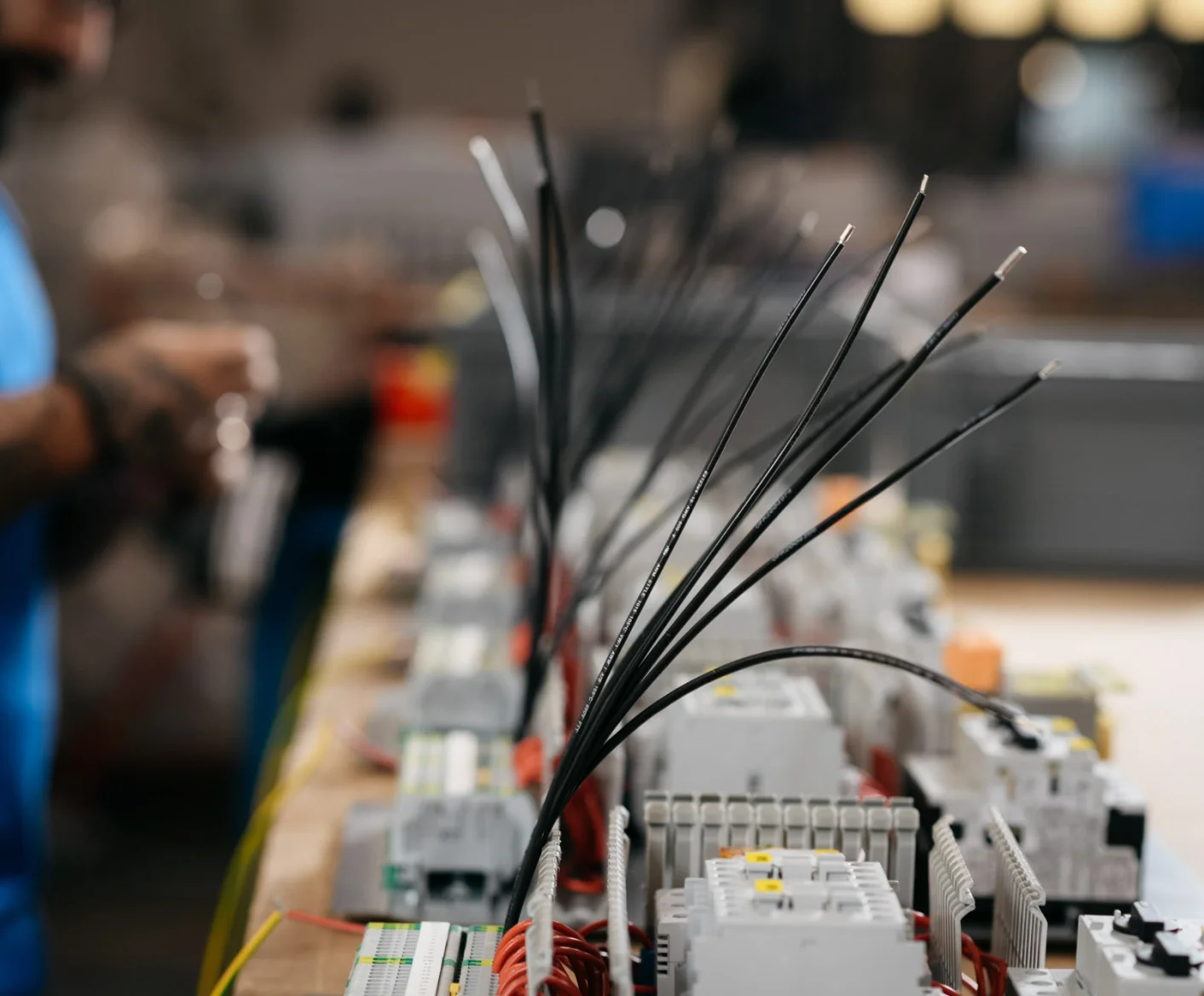
The production of industrial control panels today requires much more than the ability to assemble and wire components. For companies seeking a manufacturer of control panels, factors such as process organisation, production capacity, adherence to deadlines and quality control are key considerations when identifying the right partner for their business needs.
Over the years, in fact, the industry has developed: it has shifted from a predominantly manual activity to increasingly structured production processes, in which automation, technical expertise and organisation work together. The role of the industrial control panels manufacturer has expanded: in addition to manufacturing the product, it is necessary to be able to manage complex orders, optimise production times and ensure reliability at every stage of the process.
For a long time, we were known as ‘quadristi’ (panel builders). It is a term that reflects the origins of our profession, but one that no longer suffices to describe what we actually do. Connection has developed its expertise in line with this evolution, investing in organisation, automation and the skills required to meet our customers’ wide range of production needs.
Control panel manufacturer: why you should choose Connection.
Choosing a manufacturer of industrial control panels is not just about the production of the product itself, but rather about the ability to meet the customer’s production needs. Delivery times, order management, technical support and quality control are all factors that contribute to making a partner reliable. Here’s how Connection addresses these needs.
1. We reduce production and delivery times.
For those who manufacture machinery and industrial plants, meeting production deadlines is essential. That is why, over the years, we have invested in the organisation of production processes and in automation.
Our automatic wiring department uses machinery capable of cutting, labelling and preparing the wires required for assembly before the control panel is set up. This process allows us to speed up production times and plan deliveries with precision.
For a company selecting a manufacturer of industrial control panels, being able to rely on well-organised processes and accurate planning makes it easier to coordinate the various stages of production.
2. We handle large orders and mass production.
Every order has different production requirements. Some customers require customized control panels for specific applications, whilst others need large-scale orders or mass production. The ability to meet these different requirements is therefore a key factor when choosing a control panel manufacturer.
Our organisation and production capacity allow us to meet both of these requirements.
For the customer, this means being able to rely on a manufacturing partner capable of adapting to the specific requirements of each order, ensuring production capacity and continuity of supply even when order volumes increase.
3. We support the customer in technical assessments and sizing.
When building an industrial control panel, technical tests and sizing calculations may be required to determine the most suitable configuration for the system’s specs.
At these stages, dialogue between the client and the manufacturer can help to translate the technical specs into a practical, workable solution.
Thanks to the expertise of our technical department, we are able to support our clients throughout these activities, helping them to identify a configuration that is consistent with the project specifications.
4. We minimise the risk of unexpected issues through a dedicated testing process.
Quality control is a crucial stage in the manufacture of industrial control panels. A wiring error detected during installation can lead to delays and corrective work on the system. For this reason, testing is a fundamental stage of the production process, carried out by a specialised team that checks both prototypes and the assembled control panels.
We check whether the connections are correct, whether they correspond to the circuit diagrams, and whether they comply with the parameters set out in the project specifications, in order to identify any anomalies before delivery.
A dedicated inspection process ensures that the product is checked before it is delivered to the customer and installed in the plant.


